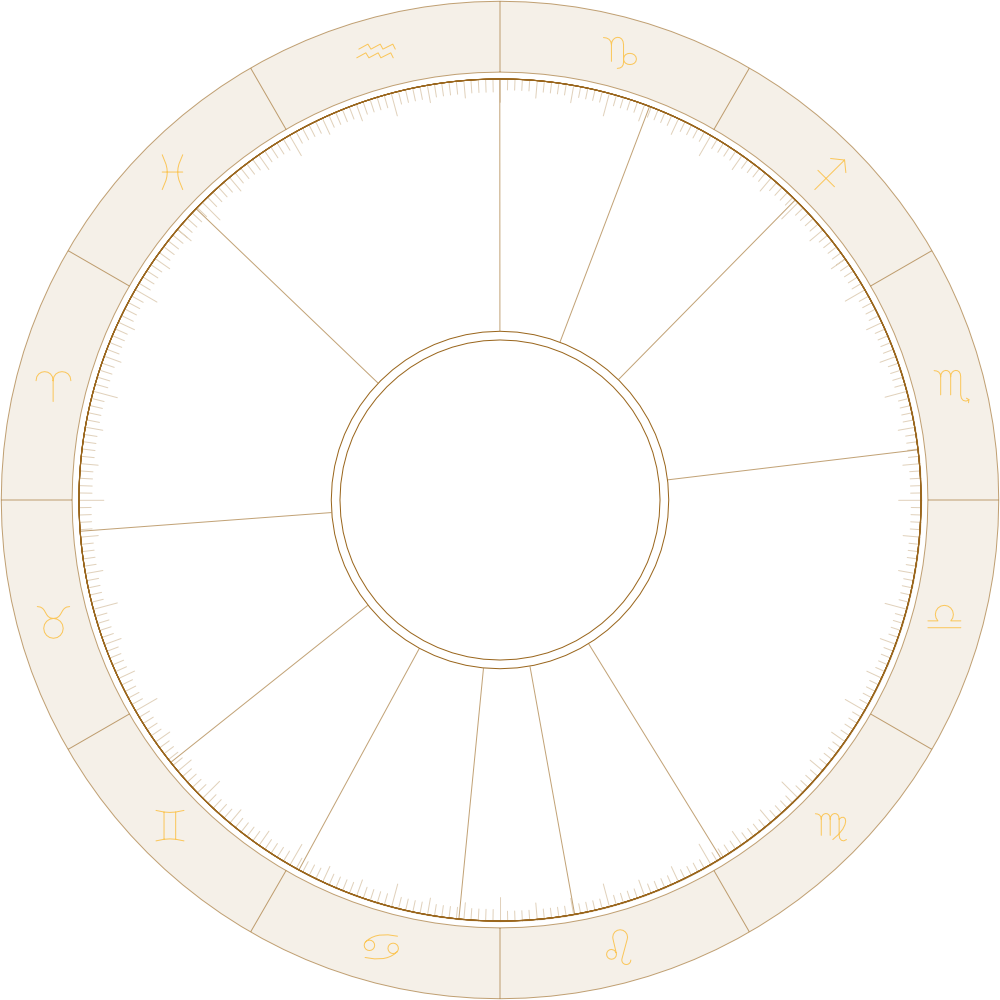
When people hear "natal chart," many picture something like an extended horoscope — a bit more detailed than the one in a magazine, but the same kind of thing. In reality it's something quite different: a precise map of the sky, fixed to one exact minute and one exact place — the moment you were born.
What it's actually made of
A natal chart has three building blocks, and each answers a different question:
- Planets are the "what" — which energy or life theme is in play (the Sun is your core, the Moon is your emotions, Mercury is how you think, and so on).
- Zodiac signs are the "how" — the style and manner in which that energy expresses itself.
- Houses are the "where" — which area of life (career, relationships, home, travel) that energy shows up most strongly in.
Separate from all three are aspects — the angles between planets, which show where energies naturally support each other and where they create inner tension instead.
Why a Sun sign alone isn't enough
A magazine horoscope is built on a single point in the chart — the Sun. It's an important point, but it's only one of dozens. A full natal chart shows how every planet, every house, and every aspect between them is arranged all at once — a full, dimensional picture of a personality, not a single slice of it.
A couple of facts that aren't always obvious
- A natal chart is, at its core, a projection of a three-dimensional sky onto a flat circle: the astronomical position of the planets gets "unfolded" into a two-dimensional wheel, tied to a specific place of observation.
- Several different systems exist for calculating houses (Placidus and whole-sign, for instance) — and with the exact same birth date, time, and place, house boundaries can shift slightly depending on which system is used. That's part of why an accurate birth time matters so much: the more precise the time, the less that difference affects the final picture.
- No natal chart repeats exactly in another person — even twins born just minutes apart can already have a noticeably different ascendant and house boundaries.
What a natal chart analysis doesn't cover
It's worth being clear: a natal chart shows the potential, inclinations, and patterns set at birth — it isn't a method for predicting specific events. That's what separate consultations like a Yearly Forecast (Solar Return) are for.
If you don't know your exact birth time
A full, precise natal chart analysis needs an accurate birth time — if you don't have one, rectification is already included in the Natal Chart Analysis consultation, if it's your first time working with me.